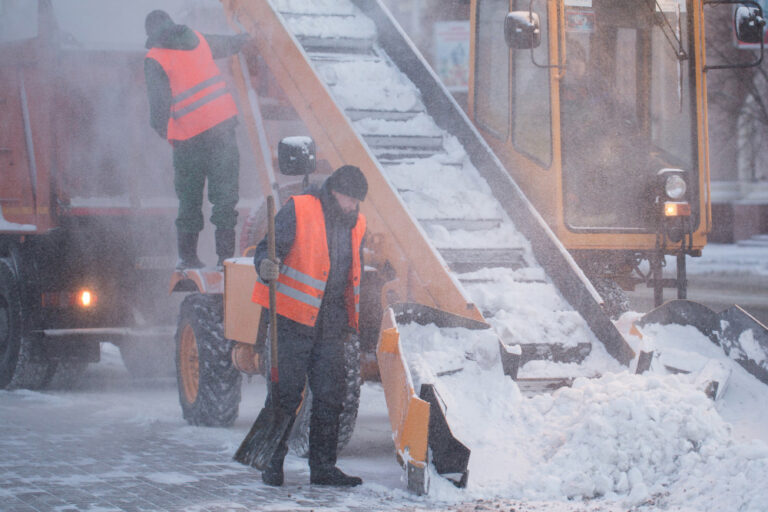
Rock salt’s practical working limit is approximately 15°F (−9°C), while its theoretical lowest melting point is approximately −6°F (−21°C).
Introduction
In battling winter’s icy grip, we often turn to salt, the traditional ice melter. But there comes a point where even salt meets its match. The question is – “at what temperature does salt stop melting ice?” Understanding this limit helps us find more efficient ways of managing winter’s ice and snow.
Key Takeaways
- Rock salt usually becomes impractically slow below approximately 15°F.
- The −6°F sodium chloride limit is theoretical, not a recommended operating temperature.
- Surface temperature matters more than air temperature.
- Salt requires moisture to form a brine that can loosen the ice–surface bond.
- Salt works more slowly as the temperature decreases.
- Thick ice and compacted snow should be removed mechanically first.
- Applying more salt does not overcome an unsuitable temperature.
- Remove loosened snow and slush to reduce refreezing.
- Use temporary traction when melting cannot create a safe surface quickly.
- Follow the selected product’s temperature range, surface restrictions and application rate.
How Salt Melts Ice
- Salt contacts moisture. Dry sodium chloride needs liquid water or surface moisture to begin forming brine.
- Brine develops. Dissolved salt lowers the freezing point of water.
- The ice–surface bond weakens. Brine works its way between the ice and pavement.
- Mechanical removal becomes easier. Loosened ice and slush can be shoveled, brushed or plowed away.
- Performance slows as temperature falls. Less liquid water is available and brine formation becomes slower.
- Refreezing remains possible. Dilution, runoff or falling temperatures can cause remaining water to freeze again.
Pros and Cons Table
|
Advantages |
Limitations |
|
Widely available |
Becomes slow in colder temperatures |
|
Generally inexpensive |
Practical performance declines near 15°F |
|
Familiar to homeowners and contractors |
Requires moisture to form brine |
|
Effective in many moderate winter conditions |
May leave chloride residue |
|
Can help loosen the ice–surface bond |
Can affect vegetation, water, metals and some surfaces |
|
Suitable for calibrated spreading equipment |
Overapplication increases waste and runoff |
|
Can be pre-wetted to improve activation |
Does not replace snow removal |

Safe Thaw
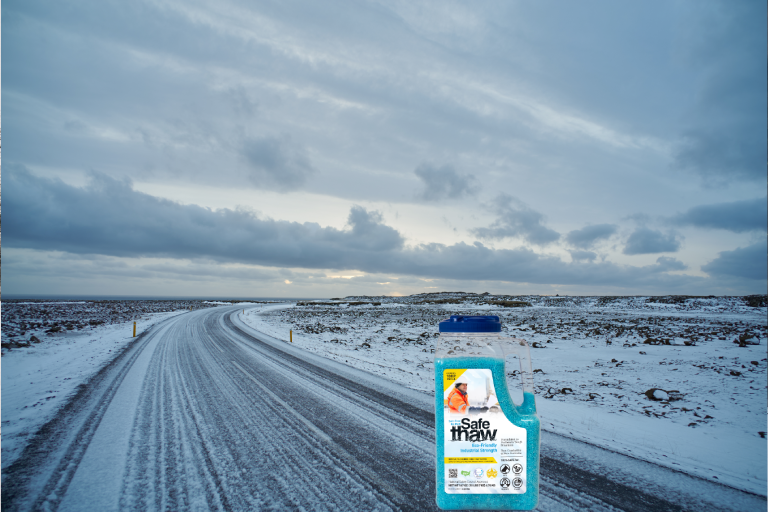
Safe Thaw was created as the ice management solution for tough winter environments.
Ideal in commercial and industrial properties, shops, government agencies,
bridges, and construction.
Warnings and Limitations
- Measure surface temperature when possible.
- Do not assume the air temperature represents pavement conditions.
- Do not increase the amount simply because the product is working slowly.
- Do not mix products unless their labels specifically permit it.
- Do not use a product on an unapproved surface.
- Avoid chloride runoff into lawns, planting beds, drains and waterways.
- Protect pets from concentrated granules and treated slush.
- Sweep up excess material after the weather event.
- Do not use deicer as a substitute for shoveling or plowing.
- Check for refreezing after treatment.
- Follow special precautions for new, damaged or poorly cured concrete.
- Use traction materials when conditions are too cold for timely melting.
Comparison Tables
|
Material |
Approximate practical lower range* |
Main advantage |
Important limitation |
|
Sodium chloride |
About 15°F (−9°C) |
Affordable and widely available |
Slow below its practical range |
|
Calcium chloride |
Product-dependent; often lower than sodium chloride |
Performs in colder conditions |
Chloride residue, handling and surface considerations |
|
Magnesium chloride |
Product-dependent; commonly below sodium chloride’s range |
Lower-temperature capability |
Chloride exposure and residue remain concerns |
|
Salt-free/chloride-free product |
Formula-dependent |
Avoids chloride exposure |
Must verify tested temperature and surface compatibility |
|
Sand or traction aggregate |
Any temperature where it remains exposed |
Immediate temporary friction |
Does not melt ice |
|
Heated system |
System-dependent |
Prevents or melts accumulation |
Installation and energy costs |
Recommendations
- Best for temperatures above approximately 20°F: Prompt snow removal followed by correctly applied sodium chloride where appropriate.
- Best near rock salt’s lower practical range: Pre-wetted treatment, mechanical removal and close monitoring.
- Best below approximately 15°F: Mechanical removal plus a product labelled for the measured surface temperature.
- Best when melting will be too slow: Sand or a suitable traction material.
- Best for recurring pedestrian areas: A documented inspection, treatment and refreezing-prevention process.
- Best for environmentally sensitive locations: Minimize total chemical use and prevent runoff from reaching vegetation and water.
- Best for new or vulnerable concrete: Follow the concrete professional’s and product manufacturer’s restrictions.
- Best for recurring high-risk areas: Correct drainage or consider a properly designed heated system.
The Limitations Of Salt
Practical working temperature
For ordinary winter maintenance, sodium chloride becomes significantly slower below approximately 15°F (−9°C). At these temperatures, maintenance professionals may change materials, pre-wet salt, increase mechanical removal or rely more heavily on traction and other operational strategies.
Theoretical eutectic temperature
A sodium chloride and water solution can remain liquid down to approximately −6°F (−21°C) at its eutectic concentration. This represents a theoretical chemical limit under controlled conditions. It does not mean that dry rock salt will rapidly or reliably clear a driveway at −6°F.
Why the two temperatures are different
Real surfaces are not controlled laboratory systems. Dry rock salt must first attract or encounter enough moisture to form brine. Cold temperatures slow this process, while snowpack, dilution, runoff, wind and limited contact with the ice further reduce performance.
Add this clarification:
In this article, “stops working” refers to the point where salt becomes operationally inefficient—not the exact point at which all chemical melting becomes impossible.
The Drawbacks Of Heating Mats
While heating mats might seem like a reliable alternative to salt, they come with their own set of issues. They are energy-intensive and often require a significant installation process. The costs of running them throughout the winter can also quickly add up, making them an inefficient solution in the long run.
Safe Thaw: The Superior Alternative
Considering the limitations of both salt and heating mats, we need a more efficient and reliable solution. That’s where Safe Thaw comes in.
- Safe Chemistry: Safe Thaw utilizes a patented dual-effect formula that breaks the surface tension and melts ice instantly, speeding up the melting process. This makes it more efficient than traditional salt, even in extremely cold temperatures.
- 100% People, Pet & Plant Safe: Unlike salt, Safe Thaw is 100% salt-free and safe for eyes, skin, and paws. It’s also safe even if ingested, ensuring an all-around safer environment for everyone.
- Surface Safe: Safe Thaw doesn’t harm your property. It’s 100% safe on all surfaces, including decking, at least 1-year-old concrete, pavers, brick, stone, etc., providing homeowners peace of mind during the icy months.
- Non-Corrosive & Non-Conductive: Safe Thaw does no damage to delicate machinery and won’t short circuit expensive equipment, unlike salt, which is corrosive and can cause extensive damage.
100% Salt & Chloride-Free, Fast-Acting Ice Management Solution
Ice Melt Temperature: Why It Matters More Than You Think
Now that we’ve explored where salt falls short, it’s natural to wonder—how much does ice melt temperature really matter when choosing a deicer? The answer is: a lot more than most people realize. Ice doesn’t behave the same way at every temperature. At 25°F, you may still see salt slowly working. But once the thermometer slides down toward 15°F or lower, you’ll notice that melting practically stalls out.
That’s why people often say, “What temperature does salt stop working on roads?” The reality is, below about 15°F, rock salt struggles to break the bond between ice and pavement. And when you go down to single digits or even subzero conditions, that bag of rock salt in the garage becomes almost useless. The ice simply wins the battle.
Safe Thaw is designed to sidestep this temperature limitation. Because of its unique formula, it doesn’t depend on a narrow ice melt temperature range. Instead, it continues to work effectively far below the threshold where rock salt gives up. That means fewer patches of dangerous black ice, less time waiting for results, and more confidence during severe cold snaps.
What Temp Does Rock Salt Stop Working, and Why It’s a Problem
You may have heard varying answers when asking, “What temp does rock salt stop working?” Some say 20°F, others insist it’s closer to 15°F. Both are technically correct depending on moisture, traffic, and application rate. But the bottom line is that once temperatures dip below that range, rock salt isn’t melting ice—it’s just sitting there.
The problem with relying on rock salt in extreme cold is that it creates a false sense of security. You may see grains scattered across your driveway or road, but the ice underneath is as slick as ever. That’s where accidents happen—cars skid, pedestrians slip, and concrete surfaces begin to take damage from both freeze-thaw cycles and corrosive salt residue.
Compare that to Safe Thaw, which maintains performance even when winter unleashes its harshest blows. Instead of relying on a chemical reaction that stalls out at low temperatures, it penetrates the surface of the ice, breaking the bond more quickly. For anyone who’s watched salt struggle while the mercury drops, this difference is a game-changer.

Best Temperature for Concrete to Cure and Why Deicers Matter
Here’s another angle people often forget: concrete itself has a temperature “sweet spot.” The best temperature for concrete to cure is between 50°F and 70°F. In that range, curing is steady and strong, giving you durable, long-lasting surfaces. But when you pour concrete late in the season—or use harsh salts afterward—you set it up for early damage.
If concrete freezes before it cures, the water inside expands, weakening the structure. Add corrosive rock salt to the mix, and you speed up cracking, scaling, and surface spalling. That’s why chloride-based salts are such a problem for new driveways, walkways, and patios.
Safe Thaw, on the other hand, is engineered to be surface-safe. Whether your concrete is fully cured or just over a year old, it won’t eat away at the surface or seep into pores, preventing the premature breakdown that plagues so many salt-treated properties.
Real-World Winter Scenarios: Roads, Driveways, and Beyond
Let’s play out a common situation. Imagine you’re driving home during a cold snap. The city spread salt earlier in the day, but now temperatures have dropped to 10°F. What happens? Despite the white crystals on the road, the surface remains icy because the ice melt temperature threshold has been crossed. That’s why you’ll often hear reports of accidents even after road crews have “treated” highways. The salt is physically present, but chemically inactive.
Homeowners face the same frustration. You may shovel, sprinkle rock salt, and wait—only to discover your walkway is still slick hours later. It’s not that you didn’t apply enough. It’s that the salt can’t function at that temperature. The result? More reapplications, more wasted product, and still no reliable safety.
100% Salt & Chloride-Free, Fast-Acting Ice Management Solution
Why Safe Alternatives Are the Future of Ice Control
When you add up the limitations of rock salt—its narrow ice melt temperature range, corrosive impact on concrete, and inability to perform in extreme cold—the conclusion becomes clear. The future of ice management isn’t about pushing more salt onto roads and driveways. It’s about smarter solutions.
Safe Thaw’s ability to stay active at temperatures where salt fails makes it more than just another product on the shelf. It’s a reliable, people- and pet-safe option that reduces long-term damage while keeping surfaces slip-free. And in a world where budgets matter, using less product for better results makes sense both financially and environmentally.

Conclusion
So, to bring it full circle: knowing the ice melt temperature limits of salt helps explain why winter safety so often feels like a losing battle. You now know the answer to questions like “what temperature does salt stop working on roads?” and “what temp does rock salt stop working?”—and the truth is, salt simply can’t handle the coldest conditions. Add to that the importance of the best temperature for concrete to cure, and it’s easy to see why pouring salt over fresh or vulnerable concrete is a recipe for disaster.
The smarter move? Choosing a non-corrosive, chloride-free product like Safe Thaw that continues to perform when traditional options fail. It’s safer for pets, plants, people, and property, while also being tough enough to face the coldest nights of the year. Winter may not compromise, but with the right solution, neither do you.
Related Ice-Melting Guides
- What Temperature Does Salt Melt Ice?
- Does Salt Really Melt Snow?
- How to Melt Snow in a Plant-Friendly Way
- Ice Melts for Stamped Concrete
- Life-Saving Tips for Driving in the Snow
- Frequently Asked Questions About Safe Thaw
Try Also Our Other Winter Safety Products
Safe Paw
The Original and #1 Selling Pet and Child Safe Ice Melt for over 20 years. Guaranteed environmentally safe – will not harm waterways and sensitive wetlands. Safe Paw can change how winter affects our planet.

Ice Traction (with Traction Magic™)
Ice Traction is your go-to winter solution for driveways, walkways, parking lots, and even black ice on the road. Unlike salt or ice melts, it delivers instant grip on snow and slippery surfaces with no wait time.
Just spread and go.
Instant Grip. Zero Melt Time.
Total Confidence on Black Ice