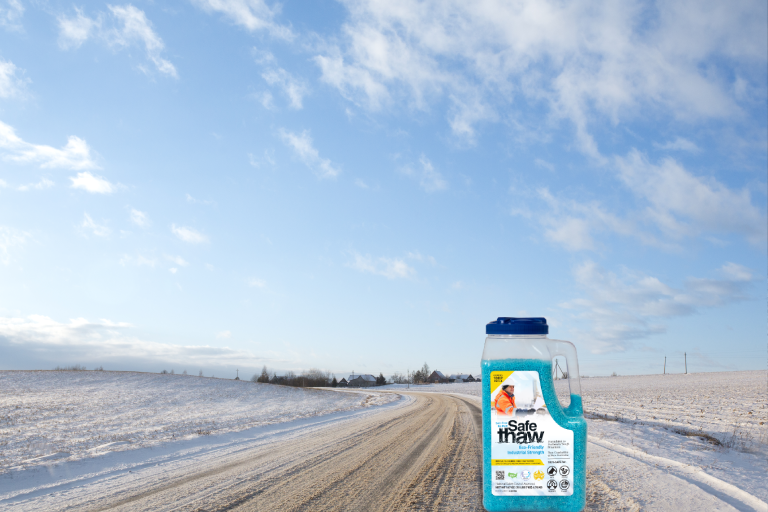
Ever pondered why ice turns to water when the weather warms up? At what temperature does ice melt? It’s like a hidden dance between temperature and science! Let’s unlock the secrets behind this mesmerizing process of ice melting. We’ll dig deep into the nitty-gritty of what makes ice say goodbye, explore different substances in the mix, and reveal why Safe Thaw is the ice-melting hero.
At What Temperature Does Ice Melt?
Pure ice melts at 0°C (32°F) under normal conditions. When salt or another soluble deicer is added, it can lower the freezing point of water, allowing ice to melt at temperatures below 0°C. However, the practical effectiveness of a deicer depends on the surface temperature, deicer type, concentration, available moisture, and application conditions.
For example, sodium chloride can form a brine with a theoretical eutectic temperature near -21°C (-6°F), but in practical winter maintenance its melting action becomes slow enough that about -9°C (15°F) is commonly treated as a lower useful working range. Safe Thaw is a chloride-free ice melt whose current product information lists low-temperature effectiveness at 10°F (-12.2°C).
FHWA distinguishes the theoretical eutectic temperature of sodium chloride brine from its practical field limitations and notes that some agencies consider salt impractical at or below roughly 15°F. (Federal Highway Administration)
Key Takeaways
- Pure ice melts at 0°C (32°F).
- Adding dissolved substances such as salt lowers water’s freezing point through freezing point depression.
- Theoretical eutectic temperature and practical working temperature are not the same thing.
- Sodium chloride becomes increasingly slow and impractical for deicing as surface temperatures approach approximately 15°F (-9°C).
- Calcium chloride and magnesium chloride brines can remain liquid at lower temperatures than sodium chloride brine, although real-world melting performance depends on concentration and conditions.
- Surface or pavement temperature matters, not just the reported air temperature.
- Safe Thaw is a chloride-free ice melt, with current product information listing effectiveness at temperatures down to 10°F (-12.2°C).
FHWA’s deicing guidance explains that freezing point varies with brine concentration and that NaCl, CaCl₂ and MgCl₂ have different phase characteristics. (Federal Highway Administration)
What is the Melting Point of Ice? Understanding Phase Changes
Picture this: ice sitting cool and solid. But when things heat up, like the rising sun in the sky, something magical happens. Ice melts! This enchanting transformation takes place when the temperature sneaks past a certain point called the melting point. For water, this magic moment is at 0 degrees Celsius (32 degrees Fahrenheit). Once the thermometer winks above this number, ice starts to party – its molecules get jiggly and excited, turning into the water we know. There know it- what temperature does ice melt at.
Melting Point vs. Practical Deicing Temperature
The melting point of pure ice and the working temperature of a deicer are different concepts. Pure ice has an equilibrium melting temperature of 0°C (32°F), while dissolved deicers can lower the freezing point of the resulting water solution.
A deicer’s lowest theoretical brine temperature should not automatically be treated as its lowest practical working temperature. In real winter conditions, dissolution, dilution, moisture availability and surface temperature affect how quickly melting occurs.
This distinction is particularly important because the current article tends to use “works at” temperatures as though they are simple fixed melting points. FHWA’s phase-diagram guidance shows why concentration and field conditions matter. (Federal Highway Administration)
Does Air Temperature or Surface Temperature Matter More?
Deicing takes place where the material contacts the ice, so the temperature of the pavement, driveway or walkway is an important factor. Air temperature can provide useful context, but it does not always match the temperature of the surface.
Sun exposure, shade, recent weather, surface material and stored heat can all cause the ground temperature to differ from the surrounding air temperature.
Why Does Ice Melt More Slowly in Colder Weather?
As temperatures fall, deicing reactions and brine formation generally become less effective. Less liquid water may be available to dissolve the material, and the ability of a particular solution to remain liquid depends on its concentration and freezing point.
This is why a deicer’s performance cannot be described by temperature alone.
FHWA explains that chemical solubility changes with temperature and that brine concentration changes as melting snow or ice dilutes the solution. (Federal Highway Administration)

Safe Thaw
Safe Thaw was created as the ice management solution for tough winter environments. Ideal in commercial and industrial properties, shops, government agencies, bridges, and construction.
Factors That Affect How Quickly Ice Melts
- Surface temperature – colder pavement generally slows melting.
- Type of deicer – different compounds produce brines with different freezing characteristics.
- Concentration – the freezing point changes according to the concentration of the dissolved material.
- Available moisture – solid deicers generally need moisture to form a brine.
- Ice thickness – thick compacted ice generally takes longer to break down than a thin layer.
- Dilution – melting snow, rain or additional water changes brine concentration.
- Application conditions – sunlight, traffic and surface conditions can influence practical results.
100% Salt & Chloride-Free, Fast-Acting Ice Management Solution
Pros & Cons
|
Deicer type |
Advantages |
Limitations |
Temperature context |
|
Sodium chloride / rock salt |
Commonly used; forms brine that lowers water’s freezing point |
Melting becomes slow in very cold conditions; chloride exposure should be considered for sensitive surfaces and environments |
Often considered impractical around 15°F (-9°C) in field use |
|
Calcium chloride |
Forms brine at temperatures lower than sodium chloride; dissolution releases heat |
Chloride-based; performance varies by concentration and conditions |
Has a lower eutectic temperature than sodium chloride |
|
Magnesium chloride |
Forms brine below the freezing point of pure water |
Chloride-based; practical effectiveness depends on formulation and conditions |
Eutectic temperature falls between sodium and calcium chloride systems |
|
Chloride-free ice melt |
Avoids chloride as the deicing component |
Performance varies considerably by formulation |
Check the product’s documented working range |
|
Safe Thaw |
Salt- and chloride-free formulation |
Use the documented product temperature range rather than assuming unlimited low-temperature performance |
Current product information lists effectiveness at 10°F (-12.2°C) |
FHWA provides the underlying NaCl, CaCl₂ and MgCl₂ brine information, while Safe Thaw’s current product specification provides the 10°F figure. (Federal Highway Administration) (safethaw.com)
Important Temperature Limitations to Understand
Temperature ratings should be interpreted carefully. A deicer’s eutectic temperature represents the lowest freezing point obtainable at a particular solution concentration; it does not guarantee fast or practical ice melting at that temperature.
Actual results can differ because of surface temperature, ice thickness, product concentration, dilution and available moisture. When evaluating any ice melt, use documented product performance information rather than assuming that its theoretical freezing point represents normal field performance.
FHWA explicitly separates phase-diagram/eutectic behavior from practical winter-maintenance performance. (Federal Highway Administration)
Safe Thaw: A Salt-Free Solution That Works Below the Freezing Point
Among these characters, Safe Thaw shines like a superstar. It’s not just about melting ice – it’s about being kind to nature. When the icy challenge gets tougher, Safe Thaw doesn’t back down. With a wide temperature range and a gentle touch, it’s a winning choice for both us and the environment.

Why the Temperature of Ice and Salt Mixture Varies by Product
Now that you know the big players in the melting game, let’s pause and think: how do these chlorides actually affect the salt and ice temperature balance? Imagine sprinkling rock salt on your driveway. The first question most people ask is—does it always work right away? Not exactly. Salt lowers the freezing point of water, but the catch is that it has limits. Once temperatures dip too low, the brine it creates simply can’t keep up, and ice stays stubbornly in place.
So, if you’ve ever found yourself staring at your driveway on a freezing morning, wondering why the salt isn’t working, the science explains it. Above -9°C (15.8°F), sodium chloride holds its ground. But go lower, and you need something stronger—hence why so many switch to harsher chloride like calcium or magnesium chloride. Yet that’s when the real risks kick in: corroded concrete, damaged greenery, and sore paws for your pets. Safe Thaw avoids that tug-of-war completely. Instead of forcing a chloride battle, it creates heat through a safe, natural reaction—no toxic fallout, just effective melting.
And if you’re wondering, at what temperature does ice melt how do you know? The answer depends on what’s on the ground. Plain ice will begin to surrender at 0°C (32°F). Add salt, and you can push that melting point lower. But with Safe Thaw, you’re not simply adjusting numbers—you’re changing the entire process.
100% Salt & Chloride-Free, Fast-Acting Ice Management Solution
At What Temperature Will Ice Melt When Mixing Salts and Water?
Here’s a common question: at what temperature will ice melt, really? It sounds simple, but it gets tricky when you mix in chlorides. Ice on its own always tips into water at 0°C. But the temperature of melting ice shifts when something is added into the equation.
Take this scenario: it’s -15°C (5°F), and you toss down rock salt. Will it melt? Not likely. The salt just sits there like a spectator. But swap it with calcium chloride, and you’ll see melting because it can push the freezing point far below what salt can handle. Still, that doesn’t mean it’s safe. What’s the trade-off? More damage to your surfaces, your soil, and your pets.
Safe Thaw, by contrast, doesn’t need to “negotiate” with ice in that same way. Even when temperatures plummet, its action remains reliable because it generates its own heat. So while most people are asking, at what temperature does ice melt how do you know if your product is even working?—with Safe Thaw, the results are visible in minutes. No guessing games, no damaged walkways.
And here’s a fun thought: next time you hear someone say, “ice always melts at 0°C,” you’ll know the truth. Yes, that’s the baseline—but what you spread on it can change the rules of the game.

Try Also Our Other Winter Safety Products
Safe Paw
The Original and #1 Selling Pet and Child Safe Ice Melt for over 20 years. Guaranteed environmentally safe – will not harm waterways and sensitive wetlands. Safe Paw can change how winter affects our planet.

Ice Traction (with Traction Magic™)
Ice Traction is your go-to winter solution for driveways, walkways, parking lots, and even black ice on the road. Unlike salt or ice melts, it delivers instant grip on snow and slippery surfaces with no wait time.
Just spread and go.
Instant Grip. Zero Melt Time.
Total Confidence on Black Ice