Ice melts at 32°F (0°C) under normal atmospheric conditions. Melting speed depends on how quickly heat reaches the ice, as well as surface temperature, sunlight, ice thickness, airflow, and dissolved substances. Salt lowers water’s freezing point, allowing melting below 32°F, although ordinary sodium chloride becomes increasingly slow for practical deicing at around 15°F (-9°C). Its approximately -6°F (-21°C) eutectic temperature is a theoretical brine limit rather than a practical temperature for clearing ice. (Federal Highway Administration)
Ice, in its purest form, is crystalline water. It guards the earth’s polar regions, leisurely floating in your summer lemonade, and often becoming an unwanted guest on your driveway or sidewalk when winter strikes. But “what temperature does ice melt?” you may wonder, and what forces drive this transformation from a rigid solid to a flowing liquid?
Key Takeaways
- Pure ice melts at 32°F (0°C) under normal atmospheric conditions.
- Reaching 32°F does not necessarily mean all ice disappears immediately; additional energy is required for the phase change.
- Sunlight, surface temperature, ice thickness, heat transfer, and airflow can affect how quickly ice melts.
- Salt causes freezing-point depression, allowing liquid water to exist below 32°F.
- Ordinary sodium chloride becomes increasingly slow for practical winter maintenance around 15°F (-9°C).
- A sodium chloride-water solution has a theoretical eutectic point of about -6°F (-21°C), but that is not a practical working temperature for dry rock salt. (Federal Highway Administration)
- Traction materials can improve grip when melting is too slow, but they do not melt ice.
What is the Melting Point of Ice? Understanding Phase Transitions
At standard atmospheric pressure, pure ice melts at approximately 32°F (0°C). At this point, added energy can be used to convert solid ice into liquid water rather than immediately increasing its temperature. This energy requirement helps explain why ice does not vanish the instant its surface reaches the melting point.
Why Ice Can Melt Faster or Slower
The melting point tells us when melting can occur, but not how quickly it will happen. Melting speed depends on heat transfer. Direct sunlight, warmer pavement, thinner ice, moving air, liquid water, and contact with warmer materials can all influence the rate at which heat reaches the ice.
Practical Salt Temperature vs. Theoretical Limit
Rock salt does not suddenly stop undergoing all chemical interaction at 15°F (-9°C). Instead, its melting action becomes slow enough that many winter-maintenance operations consider it impractical around this temperature. A concentrated sodium chloride brine can theoretically remain liquid down to approximately -6°F (-21°C), but this eutectic point should not be treated as the normal working temperature of dry rock salt. (Federal Highway Administration)
What Makes Ice Melt Fast? The Role of Chemical Deicers
In colder climes, waiting for the temperature to rise above freezing is a slow and potentially hazardous process. So, the query “how long does it take salt to melt ice?” often surfaces. The answer lies in the magic of chemistry. Salt disrupts the structure of ice, lowering its freezing point
The amount of salt, available moisture, ice thickness, and surface temperature all affect brine formation and melting speed. Applying more salt does not produce a proportional increase in melting and cannot overcome unsuitable temperature conditions.
FHWA notes that salt needs brine formation and that lower temperatures slow operational performance considerably. (Federal Highway Administration)

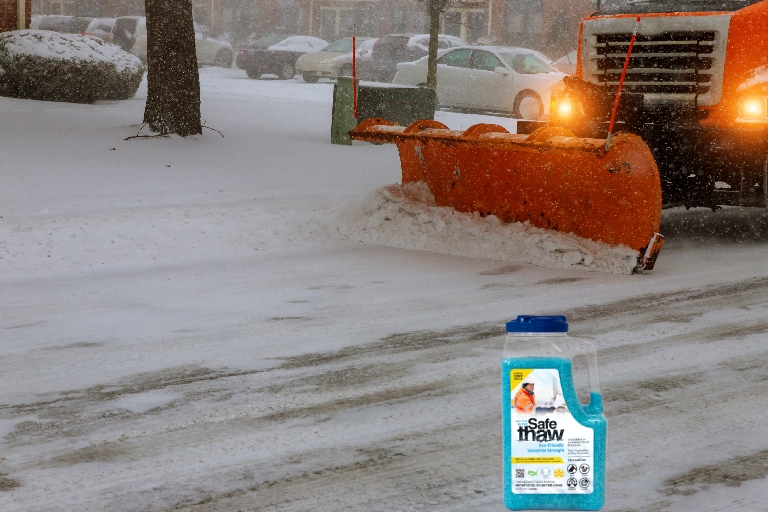
Safe Thaw
Safe Thaw was created as the ice management solution for tough winter environments. Ideal in commercial and industrial properties, shops, government agencies, bridges, and construction.
Buy NowPros & Cons
|
Method |
Advantages |
Limitations |
|
Natural warming |
Requires no applied material |
Depends heavily on weather and may be slow |
|
Mechanical removal |
Removes snow and ice directly |
Thick or bonded ice can be difficult to remove |
|
Sodium chloride |
Helps lower water’s freezing point |
Becomes increasingly slow in colder temperatures and introduces chloride |
|
Chloride-free ice melt |
Avoids chloride exposure |
Performance and surface compatibility depend on the formulation |
|
Traction material |
Can provide immediate temporary grip |
Does not actually melt ice |
|
Heated surface |
Adds heat directly |
Requires equipment and energy |
Important Limitations When Interpreting Ice-Melting Temperatures
- 32°F (0°C) refers to pure water under approximately normal atmospheric conditions.
- The temperature at which melting begins is not the same as the speed at which ice disappears.
- Air temperature and pavement temperature can differ; surface conditions are especially important for winter maintenance.
- 15°F (-9°C) is a practical sodium-chloride performance guideline, not an absolute chemical cutoff.
- The approximately -6°F (-21°C) sodium chloride eutectic point describes a concentrated brine under specific conditions and should not be interpreted as normal dry-salt performance. (Federal Highway Administration)
- Ice thickness, moisture availability, application rate and changing weather conditions can alter real-world results.
- Traction materials improve friction rather than melting ice.
Why Traditional Rock Salt Damaging to the Environment?
While using chemical ice melts like rock salt or calcium chloride seems efficient, they come with an environmental price tag. They can contaminate groundwater, damage vegetation, and pose a risk to pets and wildlife. The solution lies in an innovative product called Safe Thaw.
Safe Thaw: A Fast-Acting, Eco-Friendly Industrial Grade Ice Melt
Safe Thaw, a revolutionary ice melt, prides itself on its non-toxic and chemical-free formulation, making it perfect for industrial use. It effectively battles icy surfaces, turning them into safe zones, even in the harshest of winters. Its secret lies in a potent, yet eco-friendly formula that begins to act fast, delivering impressive ice melting performance without the environmental toll.
Safe Thaw strikes a perfect balance between efficiency and sustainability. While it tackles the ice swiftly, it doesn’t compromise on safety. So, whether you’re maintaining a large industrial facility or simply want to keep your home’s walkways clear of ice, Safe Thaw is an option worth considering.
Redefining Ice Melt
Understanding “what temperature does ice melt” is essential, but comprehending how to speed up the process without harming our environment is crucial. Safe Thaw stands out as a beacon of hope in the battle against icy surfaces, promoting safety, efficiency, and eco-friendliness. So, why not choose a product that doesn’t only care about melting ice but also cares about the world we live in?
At What Temperature Does Salt Stop Melting Ice and Snow?
Now that we know why ice melts at 32°F (0°C) and how salt interferes with the freezing process, the next logical question is: does salt work forever? The short answer is no. Salt has a limit, and once temperatures plunge too low, it simply stops being effective. So, what temperature does salt stop melting ice? Typically, rock salt (sodium chloride) stops working effectively around 15°F (-9°C). Below this, sprinkling more salt won’t make much difference—your driveway or sidewalk will remain a frozen sheet.
Here’s where it gets tricky: many people assume adding double the salt will double the melting power. But once you hit that temperature threshold, the salt is like a bystander—it just sits there. That’s one reason why harsh winters often demand alternatives that don’t rely on the same freezing-point depression method.
Ice and Salt Temperature Reference
|
Temperature |
What It Represents |
Practical Meaning |
|
32°F / 0°C |
Melting/freezing point of pure water under normal conditions |
Ice can transition between solid and liquid |
|
~15°F / -9°C |
Approximate practical lower range often used for sodium chloride |
Rock salt becomes increasingly slow for winter maintenance |
|
~-6°F / -21°C |
Approximate eutectic temperature of a 23% sodium chloride brine |
Theoretical brine limit, not normal dry-rock-salt performance |
FHWA gives the sodium-chloride eutectic composition as approximately 23% NaCl and its freezing temperature as about -6°F (-21°C), while also noting that agencies commonly find salt impractical around 15°F (-9°C). (Federal Highway Administration)
Understanding the Melting Temperature of Salt and Ice Mixtures: How Concrete Safe Ice Melt Perform
When talking about the melting temperature of salt and ice, it’s less about salt melting itself and more about how salt affects water’s freezing point. Pure table salt has its own melting temperature of about 1474°F (801°C), far beyond anything we’d deal with in a winter storm. But when salt mixes with ice and water, it creates brine—a salty solution—that lowers the ice melting temperature.
Still, it only lowers it so far. If the weather dips well below zero, even the brine freezes, and the process halts. That’s why people often look for ice melt products designed for extreme cold—ones that don’t rely solely on sodium chloride. And it’s also why Safe Thaw’s formula makes sense; it works in sub-zero conditions where salt alone would give up.
What Temperature Does Salt Stop Working in Celsius?
If you’re used to thinking in Celsius, you might wonder: what temperature does salt melt in Celsius? Pure sodium chloride melts at about 801°C, but again, that’s irrelevant to your icy steps. The more practical point is understanding at what Celsius temperature salt stops helping ice. Converting 15°F gives about -9°C. So, below -9°C, traditional salt on your driveway won’t keep you safe from slips.
This raises a fair question: what’s the use of relying on something that quits when you need it most? Salt might handle light frosts or mild snowfalls, but during a deep freeze, it won’t keep up. That’s why property owners, from industrial sites to family homes, increasingly explore chloride-free options like Safe Thaw—because winter isn’t always mild.
Real-World Ice Melting Temperature: When Chemistry Meets Climate
Here’s the kicker: science tells us the ice melting temperature is fixed at 0°C (32°F) under normal conditions. But the real world complicates things. Add salt, and you lower the freezing point. Lower the surrounding temperature too much, and the salt effect disappears. It’s a tug-of-war between chemistry and climate.
Think about it this way: if your thermometer reads -15°C (5°F), that bag of rock salt in your garage isn’t going to rescue your steps. But a product engineered to work below those limits, without damaging concrete or lawns, might. That’s where the conversation shifts from simply “what melts ice” to “what melts ice safely when salt fails?”
Conclusion: Choosing the Best Way to Melt Ice Fast and Safely
So, circling back to our original curiosity about what temperature does ice melt and how salt fits into the equation, the answer isn’t as simple as one neat number on the thermometer. Sure, ice melts at 32°F (0°C) in its pure form, but once salt enters the picture, the rules change. Depending on the concentration and conditions, the ice melting temperature can drop significantly, but it still has its limits—meaning salt eventually stops working in extreme cold.
That’s where products like Safe Thaw step in. By moving beyond corrosive salts and harnessing an eco-friendly, chloride-free formula, it delivers performance even when traditional salt-based methods quit. And isn’t that what we’re really after—safety without compromise?
Next time you’re facing down a winter storm, you’ll know the science, the chemistry, and the smarter choice. Because winter may test us, but the right knowledge—and the right tools—help us win every time.
Related Article
At What Temperature Does Salt Stop Melting Ice?
How Long Does It Take Salt to Melt Ice? Factors That Affect Ice Melting Time
What Temperature Does Salt Melt? Understanding Its Freezing Point Depression