Ice Melt Home Depot
If you have seen a significant weather event or a hailstorm or a snowstorm, you would know how important it is to use a solid ice melt that is not only safe for your roof but your environment too. Of course, you can walk into any home depot and purchase the salt you like; however, your chances of protecting your roofs are higher with Safe Thaw ice melt.
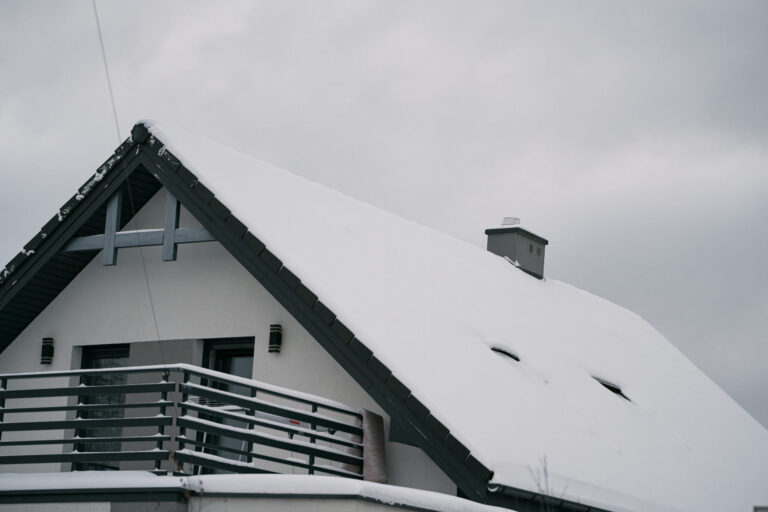
Why Ice Forms Along Slanted Roofs
Ice dams form when snow melts on a warmer upper section of a roof and the water refreezes near a colder eave. The resulting ice ridge can prevent later meltwater from draining normally. Water may then collect behind the ice and enter gaps in the roof covering. Uneven roof temperature is commonly associated with indoor heat loss, air leakage, insulation gaps, or roof-design conditions.
Check the Roofing Material Before Applying Ice Melt
Roof compatibility depends on more than whether a roof is slanted. The shingles, membrane, metal panels, protective coatings, flashing, fasteners, sealants, gutters, and nearby drainage surfaces may respond differently to a deicing material. Review both the ice-melt instructions and the roofing manufacturer’s care guidance before application.
Ice Melt Is a Short-Term Measure
Applying ice melt to a localized icy area may help create a drainage path or loosen a limited accumulation. It does not correct the temperature differences that cause recurring ice dams. Long-term control normally focuses on reducing air leakage and heat transfer into the roof assembly and maintaining an appropriate roof design.
Key Takeaways
- Safe Thaw is described in its published product information as a salt-free and chloride-free ice melt.
- Do not assume that one ice melt is suitable for every roofing material or roof coating.
- Confirm compatibility with the roofing manufacturer before applying any deicer.
- Treat only the affected area and follow the application rate on the current product label.
- Do not chip, scrape, or strike ice in ways that could damage shingles, flashing, or gutters.
- Ice melt may provide temporary assistance, but recurring ice dams usually indicate a heat-loss or roof-temperature problem.
- Avoid walking on a snow-covered or icy sloped roof. Arrange professional assistance when the area cannot be treated safely from the ground.
100% Salt & Chloride-Free, Fast-Acting Ice Management Solution
How to Apply Ice Melt to a Slanted Roof Area
- Identify the affected area. Determine whether the problem is loose snow, a localized ice patch, a blocked drainage path, or a larger ice dam.
- Confirm roof compatibility. Review the roofing manufacturer’s guidance for the shingles, membrane, metal, coating, flashing, and gutters.
- Check the current product instructions. Confirm the permitted surfaces, application rate, temperature range, and required precautions.
- Remove accessible loose snow carefully. Use a roof-appropriate tool from the ground when this can be done without scraping or striking the roof.
- Treat only the required area. Apply the measured amount evenly instead of forming large piles or concentrated pockets.
- Keep drainage routes open. Observe where meltwater will travel and avoid directing it toward entrances, walkways, or areas where it can refreeze.
- Reassess the cause. If ice returns repeatedly, investigate air leakage, insulation, ventilation, roof geometry, and gutter drainage.
Why this helps
Numbered instructions are easier to extract as a procedure. The steps also correct the current recommendation to place the product in “smaller pockets,” which could encourage uneven or excessive application unless supported by the label.
Advantages and Limitations of Using Ice Melt on a Roof
|
Potential advantage |
Limitation |
|
Can assist with a localized area of ice |
Does not correct the cause of recurring ice dams |
|
May help open a temporary meltwater path |
Compatibility varies by roofing and drainage materials |
|
Requires less mechanical contact than chopping ice |
Meltwater may refreeze at the eave, gutter, downspout, or ground |
|
A chloride-free formulation avoids adding chloride salts |
“Chloride-free” does not automatically establish compatibility with every roof |
|
Measured application can target a specific area |
Overapplication wastes material and may increase runoff or residue |
Warnings and Limitations
- Do not walk on an icy or snow-covered sloped roof to apply a product.
- Do not chip ice with a hammer, axe, shovel edge, or other tool that could damage the roof covering.
- Do not claim compatibility with asphalt shingles, cedar, slate, tile, rubber membranes, or coated metal unless documentation supports that particular material.
- Keep granules and meltwater away from locations where runoff can refreeze and create a ground-level slip area.
- Stop and arrange an inspection if the roof is leaking, visibly deformed, unusually loaded, or has damaged shingles, flashing, gutters, or fasteners.
- Ice melt should not be presented as a permanent solution for recurring ice dams.
Can Safe Thaw be used on the Shingled Roof?
Yes, you can safely use it on any shingled or slanted roof of residential or commercial spaces.
Safe Thaw is a unique ice melt spreader comprising a patented dual-effect compound of crystalline amide core infused with special glycol admixture and traction agents. It is a timed-release action and starts working as soon as it touches the icy surface. You can spread

Safe Thaw on the roof before a snowstorm hits to avoid the snow from sticking to the roof. While you may have a slanting roof, you can use the ice melt in smaller pockets and spread it evenly on the roof. Since it is 100% natural and environment-friendly, your roofing material has minimal chance of damage. In addition, Safe Thaw has gone through extensive testing on all different roofing materials to check its durability, reliability, and longevity.
Since it also has traction agents, you can apply it after snowfall after you have cleared the excess snow layer, if needed. The liquid that leaches from the core starts acting with the ice and breaks the surface tension on the roof. In addition, it attracts solar heat to provide extra melting power during the day, thus enabling a quicker reaction on the icy surface.
The excess water then goes down the gutter or storm drain, saving your roof from mold formation, seepage, and any internal ceiling damage.
100% Salt & Chloride-Free, Fast-Acting Ice Management Solution
Conclusion
So, while you wonder ‘how to melt ice on the driveway without using salt?’, you must also take care of your roof. Using Safe Thaw helps you get the desired reaction, does not clog drains, does not harm your landscape, and is 100% safe for kids and pets. In addition, your roofs last longer with the correct application of the product. However, do ensure you do not over-apply since it would not act any faster. You can use a pound of the product on 100 square feet.