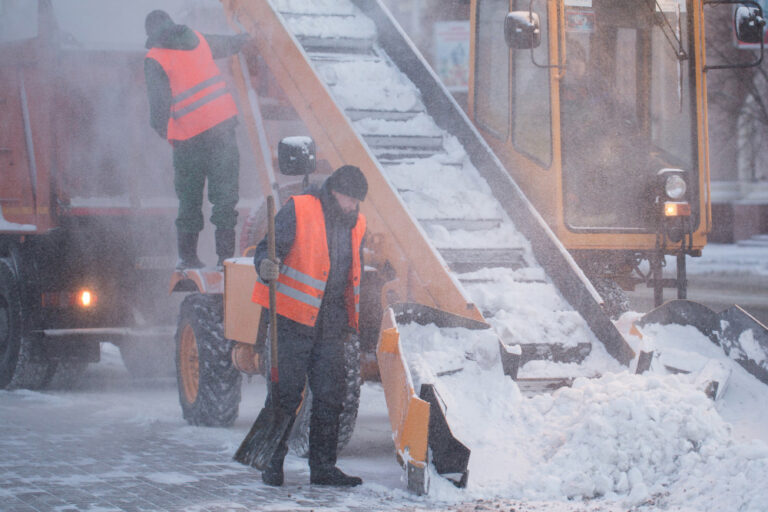
Salt melts ice by dissolving in liquid water on the ice surface and forming a brine with a lower freezing point than pure water. Sodium chloride separates into sodium and chloride ions in the water, which lowers the temperature at which that solution freezes. Ice then melts until the ice-brine system reaches a new equilibrium. As temperatures fall, salt works increasingly slowly and becomes less practical for winter maintenance
Salt has been used for decades to melt ice on driveways and roads, but how exactly does this process work? Understanding the science behind salt’s ice-melting abilities is essential, not just for effective snow and ice management, but also for recognizing its environmental and infrastructural impacts.
Freezing Point Depression
Salt, when applied to ice, lowers the freezing point of water. This phenomenon, known as freezing point depression, means that water needs to be colder than 32°F (0°C) to freeze. This is why salt melt ice is effective in preventing ice formation even in sub-freezing temperatures. However, this effect diminishes in extremely cold temperatures, reducing its effectiveness.

Safe Thaw
Safe Thaw was created as the ice management solution for tough winter environments. Ideal in commercial and industrial properties, shops, government agencies, bridges, and construction.
Buy NowEndothermic Reactions
Sodium chloride does not perform equally at every temperature. The freezing point of a salt-water solution depends on its salt concentration. For sodium chloride, the lowest freezing point occurs near a 23% salt concentration at approximately -6°F (-21°C). In real winter-maintenance conditions, however, sodium chloride becomes much slower and often impractical at substantially warmer temperatures, around 15°F (-9°C).
Dilution Can Lead to Refreezing
As salt melts snow or ice, additional water enters the brine and lowers its salt concentration. If the brine becomes too diluted for the existing pavement temperature, the solution can freeze again. FHWA specifically notes that dilution changes the solution’s freezing point and can result in refreezing.
Key Takeaways
- Salt does not melt ice simply by “heating” it. Its main deicing effect comes from lowering the freezing point of water after dissolving into a brine.
- Sodium chloride needs liquid water to work. Solid salt must begin dissolving before meaningful freezing-point depression occurs.
- Salt becomes much less practical in very cold conditions. FHWA notes that many agencies consider sodium chloride too slow for general snow and ice control around 15°F (-9°C).
- 15°F is not sodium chloride’s absolute thermodynamic limit. A roughly 23% sodium-chloride brine has a eutectic temperature around -6°F (-21°C), but practical field performance becomes poor well before that point.
- Dilution matters. As melting ice adds water to the brine, its concentration decreases and refreezing can occur if the solution’s freezing point rises above the pavement temperature.
- Chloride from deicing applications can move into surface water and groundwater, and elevated chloride can affect freshwater ecosystems.
Chloride Does Not Disappear After the Ice Melts
Melting the ice does not remove the sodium or chloride. Chloride is highly mobile in water and can move with runoff and groundwater toward streams and other receiving waters. USGS has documented increasing chloride concentrations in urban watersheds influenced partly by deicing applications.
Repeated deicer exposure can also contribute to deterioration of susceptible concrete. FHWA identifies deicer scaling as a recognised concrete distress mechanism and notes that deicing chemicals can amplify freeze-thaw-related deterioration.
Osmosis And Dehydration
Osmosis plays a role in how salt melt ice. The salt on the surface of the ice creates a saline solution that has a lower concentration of water molecules compared to the inside of the ice. Water molecules from the ice move towards this saline solution to equalize concentration, effectively dehydrating the ice and causing it to melt.
100% Salt & Chloride-Free, Fast-Acting Ice Management Solution
4. The Re-Freezing Problem
While salt effectively melts ice, it can lead to a re-freezing issue under certain conditions. As temperatures drop, particularly at night, the melted water can re-freeze, forming black ice, which is a significant hazard on driveways and roads. This cycle of thawing and re-freezing creates a continuous need for the reapplication of salt, which can be both cumbersome and costly.
Pros & Cons
|
Factor |
Advantage |
Limitation |
|
Ice melting |
Lowers the freezing point after forming brine |
Performance slows considerably as temperature falls |
|
Availability |
Widely used in winter maintenance |
Application must still match pavement temperature and conditions |
|
Mechanism |
Well-understood freezing-point depression |
Requires sufficient moisture for solution/brine formation |
|
Temperature |
Effective across common moderate winter conditions |
Often considered impractical around 15°F (-9°C) or colder for general salt-only operations |
|
Refreezing |
Brine can prevent bonding while sufficiently concentrated |
Dilution can raise its freezing point and allow refreezing |
|
Environment |
Supports snow-and-ice control |
Chloride can move into soil, groundwater and surface water |
|
Infrastructure |
Helps maintain winter mobility |
Repeated deicer exposure can contribute to concrete deterioration and corrosion-related problems |
Warnings and Limitations
Do not treat one temperature as the point where salt suddenly “stops working.” Sodium chloride performance decreases progressively as conditions become colder. Around 15°F (-9°C), many highway agencies consider its action too slow for practical salt-only winter maintenance, while the theoretical eutectic temperature of sodium-chloride brine is much lower, around -6°F (-21°C).
Salt performance also depends on pavement temperature, moisture, concentration, application method and dilution. A laboratory phase-limit value should therefore not be presented as the same thing as useful field performance.
Environmental and surface effects also depend on application rate, exposure, drainage, material condition and repeated use. Avoid wording that implies every individual salt application automatically causes concrete failure or environmental damage. FHWA describes deicer deterioration as a multi-factor process rather than a single universal outcome.
Environmental And Infrastructure Impact
The extensive use of salt for driveways has significant environmental and infrastructural impacts. Salt runoff contaminates soil and water bodies, affecting both plant life and aquatic ecosystems. Additionally, salt accelerates corrosion in metals and damages concrete, leading to increased maintenance and repair costs for infrastructure.

Safe Thaw: A Safer Alternative
Given these considerations, it’s crucial to explore alternatives. Safe Thaw offers a solution that is non-corrosive, chloride-free, and toxin-free. Its unique formula, featuring a patented dual-effect compound of a modified crystalline amide core infused with special glycol admixture and traction agents, ensures long-term effectiveness without the harmful side effects associated with traditional salt-based ice melts. This makes Safe Thaw an ideal option for industrial and residential use, ensuring safety and efficacy.
Conclusion
While traditional salt melt ice methods are widely used, they come with significant drawbacks. Understanding the scientific facts behind how salt melts ice helps in making informed decisions about ice management. Switching to environmentally friendly alternatives like Safe Thaw not only addresses these concerns but also offers a sustainable approach to dealing with winter’s challenges.
Try Also Our Other Winter Safety Products
Safe Paw
The Original and #1 Selling Pet and Child Safe Ice Melt for over 20 years. Guaranteed environmentally safe – will not harm waterways and sensitive wetlands. Safe Paw can change how winter affects our planet.

Ice Traction (with Traction Magic™)
Ice Traction is your go-to winter solution for driveways, walkways, parking lots, and even black ice on the road. Unlike salt or ice melts, it delivers instant grip on snow and slippery surfaces with no wait time.
Just spread and go.
Instant Grip. Zero Melt Time.
Total Confidence on Black Ice