More dry ice, larger blocks and better insulation increase storage time. Warm temperatures, moving air, small pellets and contact with water make it sublimate faster.
Dry ice, unlike the typical ice made from water, is the solid form of carbon dioxide. It has fascinated people for decades due to its chilly -78.5°C (-109.3°F) temperature and its propensity to “vanish” into a misty cloud instead of turning into liquid. This peculiar behavior leads many to ask the question, “how long does it take for dry ice to melt?” Understanding the science behind dry ice and its sublimation process is not only fascinating but practical.
Key Takeaways
- Dry ice is solid carbon dioxide and sublimates instead of melting.
- There is no single universal dry-ice duration.
- Large blocks generally last longer than small pieces or pellets.
- Insulation slows sublimation; heat, airflow and water accelerate it.
- Dry ice can cause severe cold burns or frostbite.
- Carbon dioxide can accumulate in enclosed or poorly ventilated spaces.
- Never store dry ice in an airtight container.
- Dry ice is used for cooling and fog effects; it is not a driveway ice-melting product.
What is Dry Ice and Does Ice Evaporate Faster Than Water?
Before we delve into the specifics of dry ice’s duration to melt, or rather “sublimate,” it’s important to grasp what makes it different from regular ice.
When exposed to room temperature, dry ice doesn’t melt in the conventional sense. Instead, it undergoes a process called sublimation, where it directly transitions from a solid to a gas. This is why you never see a puddle of liquid around dry ice; it turns into carbon dioxide gas.

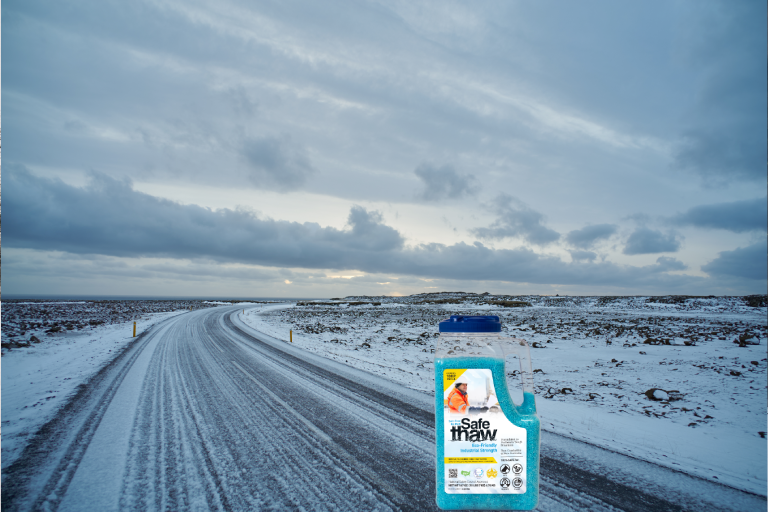
Safe Thaw
Safe Thaw was created as the ice management solution for tough winter environments.
Ideal in commercial and industrial properties, shops, government agencies,
bridges, and construction.
Dry Ice Evaporation Time: Factors That Affect Sublimation Speed
The exact answer to “how long does it take for dry ice to melt” isn’t straightforward. Various factors determine the speed at which dry ice sublimates, including:
- Surface Area Exposure: A larger chunk of dry ice will take longer to sublimate than smaller pieces or pellets exposed to the same conditions.
- Temperature: Naturally, in warmer temperatures, dry ice will sublimate faster. In a typical room temperature setting, a pound of dry ice could sublimate completely in three to six hours. However, in a cooler setting, it might take much longer.
- Air Circulation: An area with more airflow will speed up the sublimation process. For example, dry ice left outside where there’s a breeze will vanish quicker than in a closed room.
- Insulation: If dry ice is stored inside an insulated container, it will last longer. Proper storage can prolong the life of dry ice for a few days.
Best Practices for Handling Solid Carbon Dioxide Safely
Due to its extremely cold temperature and the fact that it turns into carbon dioxide gas, there are some safety measures to consider:
- Avoid Direct Contact: Dry ice can cause frostbite upon direct contact with skin. Always use gloves or tongs when handling it.
- Store in Ventilated Areas: As dry ice sublimates, it releases carbon dioxide gas. This can lead to a dangerous buildup in closed spaces. Ensure the area is well-ventilated.
- Do Not Consume: Ingesting dry ice can cause severe internal injury.
100% Salt & Chloride-Free, Fast-Acting Ice Management Solution
How to Dispose of Dry Ice Safely: Proper Sublimation Steps
The matter of disposing of dry ice can sometimes be a dilemma, especially if you’re unfamiliar with its properties. Here’s a safe approach:
- Let It Sublimate: The easiest way to dispose of dry ice is to let it sublimate in a well-ventilated space. This way, it will naturally turn into carbon dioxide gas and dissipate.
- Avoid Flushing: Never try to flush dry ice down a sink or toilet. The extreme cold can damage your plumbing.
- Outdoor Disposal: If you’re disposing of large quantities, it’s best to do it outdoors to avoid the risk of carbon dioxide buildup in enclosed spaces.

Keeping Your Driveway Safe: Dry Ice vs. Winter Ice Management
While dry ice and its sublimation are intriguing, winter ice presents its own challenges. Slippery driveways and walkways can pose a risk during the cold months. Using a chemical and toxin-free, industrial-use ice melt like Safe Thaw ensures safety. Its granular formula effectively melts the ice without causing harm to the environment or concrete surfaces. A perfect solution for a slip-free winter.
Submersion Rates: How Long Will Dry Ice Last in Water?
Once you’ve seen dry ice at room temperature, the next question people often ask is, “what happens if I put it in water?” The answer is—it sublimates much faster. When submerged, dry ice reacts immediately with the warmer temperature of water, creating that thick fog effect people love at parties. But it’s short-lived.
So how long will dry ice last in water? Not long at all. A block that may have lasted three to six hours in a cooler could be gone in less than 15 to 20 minutes when placed in a bucket of warm water. Even in cold water, the process accelerates compared to air exposure. That’s why entertainers or event organizers keep adding fresh dry ice during the evening to maintain the smoky effect.
And while it’s fascinating to watch, remember—carbon dioxide gas is being released rapidly. You don’t want to do this in a closed space. Always ensure there’s ventilation, or better yet, stick to outdoor demonstrations.
100% Salt & Chloride-Free, Fast-Acting Ice Management Solution
Special Effects Guide: How Long Does Dry Ice Smoke Last?
That dramatic fog effect is what makes dry ice so popular, but it’s easy to overestimate its staying power. How long does dry ice smoke last really depends on two things: water temperature and the size of the dry ice piece. The hotter the water, the bigger and denser the fog cloud—but the faster your dry ice vanishes. In very warm water, the smoke might only last 5 to 10 minutes per chunk.
If you want it to linger, cooler water slows down the sublimation. This way, you get a thinner but longer-lasting smoke effect, maybe 20 to 30 minutes per block. That’s why stage designers often switch between hot and cool water setups depending on whether they need an explosive fog burst or a steady background haze.
The takeaway? You can’t stretch smoke for hours on end. If you need a longer performance, you’ll have to keep feeding in new pieces of dry ice.
DIY Science: How to Make Dry Ice at Home Safely
Curiosity often leads people to wonder, “can I make dry ice myself?” Technically, yes—you can produce it by releasing compressed liquid carbon dioxide into a bag or container, where it instantly freezes into dry ice snow. But here’s the catch: you need specialized equipment like a CO₂ fire extinguisher or pressurized tank, and you have to handle it extremely carefully.
So while you can explore how to make dry ice at home, most experts don’t recommend it unless you’re doing it as a supervised science project with proper safety gear. Dry ice is powerful, and mishandling it can lead to burns or dangerous gas buildup. It’s usually safer, cheaper, and more reliable to buy it from a supplier than trying to whip it up in your garage.
Cold Storage: How Long Does Dry Ice Stay Cold in a Cooler?
This is where practical use comes in. Campers, shippers, and even grocery stores often ask: “how long does dry ice stay cold for?”
In a standard insulated cooler, 10 pounds of dry ice can keep items frozen for 24 to 48 hours. If you’re storing it in a deep freezer or specialized container, you can stretch that timeline even longer. But outside a cooler, left in a room, that same block may vanish within hours.
It’s important to note that dry ice doesn’t just “stay cold”—it’s actively releasing carbon dioxide as it sublimates, which means the cooling effect is consistent until it’s gone. For transport, it’s ideal because unlike water ice, it doesn’t leave messy puddles behind. Still, the key is insulation: the better the container, the longer your dry ice will last.
Dry Ice Duration Guide
| Situation | Approximate Planning Range | Important Variables |
|---|---|---|
| Small amount at room temperature | Several hours | Weight, surface area, airflow, and room temperature |
| Approximately 10 lb in a vented insulated cooler | About 24–48 hours | Cooler quality, opening frequency, and ambient temperature |
| Small pieces in warm water | Often minutes rather than hours | Water temperature and piece size |
| Fog effect in water | Commonly 5–30 minutes per addition | Quantity, water temperature, and desired fog density |
| Shipping or cold storage | Supplier-specific | Package design, insulation, transit time, and product load |
Pros and Cons Table
| Advantages | Limitations |
|---|---|
| Provides very low-temperature cooling | Can cause severe frostbite or cold burns |
| Sublimates without leaving liquid water | Releases carbon dioxide gas |
| Useful for temperature-controlled transport | Requires ventilation |
| Produces a dense low-lying fog in water | Fog duration is limited and variable |
| Available as blocks, slices, or pellets | Cannot be stored in a sealed container |
| Useful when water residue is undesirable | Not suitable as a driveway ice-melting treatment |

Comparison Tables
| Feature | Dry Ice | Water Ice | Driveway Ice-Melting Product |
|---|---|---|---|
| Material | Solid carbon dioxide | Frozen water | Product-specific formulation |
| Main purpose | Cooling and fog effects | Cooling | Managing ice on outdoor surfaces |
| What happens when warmed | Sublimates into gas | Melts into water | Works according to its labelled mechanism |
| Leaves liquid water | No | Yes | Depends on ice, temperature, and drainage |
| Main safety concern | Frostbite and CO₂ accumulation | Slipping and cold exposure | Depends on ingredients and application |
| Suitable for driveways | No | No | Yes, when labelled for the surface and conditions |
| Storage requirement | Vented, insulated container | Freezer or insulated container | Dry storage following label directions |
Recommendations
- Best for temporary ultra-cold storage: Dry ice, when the package is designed for it and appropriate ventilation is provided.
- Best for ordinary food or beverage cooling: Water ice or reusable cold packs, where suitable.
- Best for theatrical fog: Dry ice used with controlled water and adequate ventilation.
- Best for driveways and walkways: A purpose-made ice-management product selected for the surface, weather and application requirements.
- Best for commercial winter operations: A documented ice-management plan covering treatment, traction, application rate, storage and worker safety.
The Winter Connection: Dry Ice vs. Household Ice Melt
It’s tempting to draw parallels between dry ice and ice melts because both involve battling frozen surfaces. But their purposes are entirely different. Dry ice is used for cooling and special effects, not for safety on driveways or rooftops. In fact, placing dry ice directly on concrete could cause cracking due to the thermal shock.
That’s where products like Safe Thaw stand apart. While dry ice fascinates with its fog and cold storage uses, Safe Thaw addresses the real daily problem of slippery surfaces in winter. Unlike calcium chloride or sodium chloride products that harm cement, Safe Thaw works without damaging driveways, decks, or roofs—and it’s safe around kids, pets, and vegetation.
Industrial facilities, commercial complexes, and homeowners alike lean on Safe Thaw because it solves a different problem: not preserving goods or entertaining guests, but keeping people safe from slips and falls while protecting property.
Conclusion: Mastering Dry Ice Evaporation and Winter Safety
Dry ice is a marvel—it skips the liquid phase, smokes dramatically in water, and keeps things frozen without mess. But knowing how long will dry ice last in water, how long does dry ice smoke last, or how long does dry ice stay cold for helps you set realistic expectations. It’s powerful, but fleeting, and requires careful handling.
On the other hand, when the conversation shifts from science experiments to everyday winter safety, only one solution consistently rises to the top—Safe Thaw. Unlike dry ice or chloride salts that bring risks with them, Safe Thaw is built for real-world use on driveways, sidewalks, and rooftops. It’s chloride-free, toxin-free, and trusted in industrial and commercial spaces just as much as at home.
So while dry ice may intrigue your inner scientist, Safe Thaw is the practical hero that keeps your property safe through every storm.
Warnings and Limitations
- Wear loose-fitting insulated or cryogenic gloves and appropriate eye protection.
- Use or store dry ice only in a well-ventilated area.
- Never place dry ice in an airtight container; gas buildup can cause the container to rupture.
- Do not keep dry ice in an enclosed vehicle, occupied room or unventilated cooler.
- Do not eat dry ice or place it directly into a drink where it could be swallowed.
- Keep it away from children and pets.
- For workplace use, follow the supplier’s Safety Data Sheet and applicable occupational-safety procedures.
Try Also Our Other Winter Safety Products
Safe Paw
The Original and #1 Selling Pet and Child Safe Ice Melt for over 20 years. Guaranteed environmentally safe – will not harm waterways and sensitive wetlands. Safe Paw can change how winter affects our planet.

Ice Traction (with Traction Magic™)
Ice Traction is your go-to winter solution for driveways, walkways, parking lots, and even black ice on the road. Unlike salt or ice melts, it delivers instant grip on snow and slippery surfaces with no wait time.
Just spread and go.
Instant Grip. Zero Melt Time.
Total Confidence on Black Ice